
Expert articles and technical knowledge on laboratory furniture, ESD workstations, and cleanroom design
Guiding engineering and procurement teams with compliance, durability, and ergonomic insights
In-depth technical guides for specialized research and manufacturing environments
Innovations and practical tips for ESD protection, heavy-duty workbenches, and ergonomic setups
A Heavy Duty Industrial Workbench is more than a thick tabletop with steel legs. It is a controlled workspace for machining, assembly, maintenance, testing, and repair. In a busy factory, the right bench must support heavy loads without excessive movement. It should also protect tools, materials, and operators during long shifts.
This guide examines ten common industrial workbench types and the tasks they support. Options include modular benches, mobile workstations, welding tables, electronic assembly benches, packing stations, and adjustable-height designs. Each type solves a different workplace problem. A mobile bench may improve flexibility, while a fixed steel bench can provide greater stability for demanding operations.
Details matter. Check the rated load, frame construction, work-surface thickness, drawer capacity, and leveling feet. A smooth laminated top may suit assembly work, while a steel or butcher-block surface may handle harsher conditions. Consider lighting, power outlets, grounding, storage access, and operator height before choosing.
Small mistakes become expensive. A bench that fits the room may still obstruct forklifts or create awkward reach distances. No design is perfect. Even durable finishes can wear near vise mounts and welding areas. Reliable selection depends on verified specifications, practical measurements, and feedback from experienced users. The following comparison focuses on real working conditions, not attractive catalog photographs.
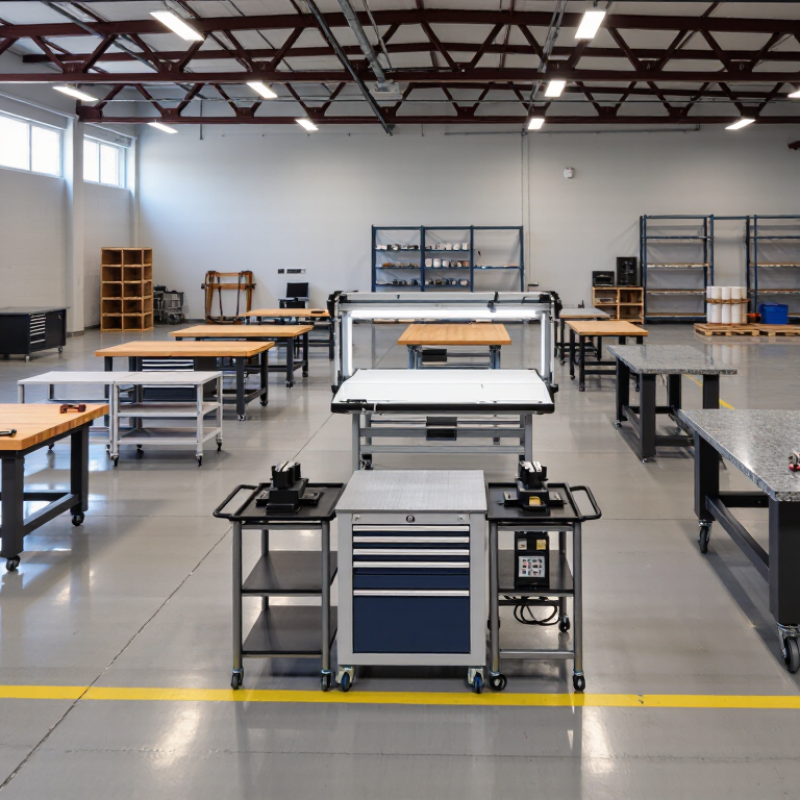
What Are the Top 10 Heavy Duty Industrial Workbench Types?
Definition and Core Features of Heavy-Duty Industrial Workbenches
A heavy-duty industrial workbench is a stable work platform built for demanding tasks, equipment, and repeated daily use. Unlike a light workshop table, it uses reinforced steel frames, thick work surfaces, and dependable load distribution. In practical settings, technicians may place motors, tool cases, vises, and metal parts on the same bench.
Strength matters, but it is not the only measure. A quality workbench should resist vibration, surface deflection, corrosion, and accidental movement. Adjustable leveling feet help maintain stability on uneven concrete floors. Some benches include drawers, shelves, pegboards, casters, or overhead lighting. These features improve workflow when they match the actual process.
There are many types, including fixed steel benches, mobile benches, height-adjustable models, modular stations, packing tables, welding benches, machine benches, ESD workstations, cleanroom benches, and drawer-based units. Each design serves a different environment. ESD models protect sensitive electronics, while welding benches need heat-resistant surfaces and grounding provisions. Mobile units save space, but their casters can reduce stability under heavy loads.
A useful selection begins with the task, not appearance. Check the working load, surface dimensions, floor condition, and operator posture. A 2,000-pound rating may sound impressive, yet it can mislead if the weight is unevenly placed. I have seen oversized benches create poor reach zones and unnecessary lifting. The strongest option is not always the safest or most efficient.
Typical rated load capacity by workbench type
The chart compares representative rated load capacities commonly specified for heavy-duty industrial workbenches. Actual capacity depends on frame construction, tabletop material, leveling, casters, anchoring, and the manufacturer’s engineering standards. Machine, welding, and modular workbenches generally support the highest loads, while mobile and cleanroom models prioritize flexibility or controlled environments.
The ten main types of heavy-duty industrial workbenches serve different production demands. Fixed steel workbenches provide stable support for heavy tools and large parts. Modular workbenches use replaceable shelves, drawers, and frames as workflows change. Mobile workbenches add lockable casters for maintenance teams moving between stations. Height-adjustable benches support safer posture during long shifts. Their lifting systems still need regular inspection.
Welding workbenches use thick steel tops, heat-resistant surfaces, and grounding points. Machine workbenches reduce vibration beneath grinders, presses, or compact equipment. Electronics workbenches often include ESD-safe surfaces, cable channels, and focused lighting. Stainless steel workbenches suit wet areas, laboratories, and food-processing environments. Cleanroom workbenches use smooth, low-shedding materials that simplify contamination control. A clean surface helps, but careless storage can defeat it.
Woodworking workbenches combine rigid frames with clamping features for boards and panels. Choosing among these types requires more than comparing load ratings. Measure the floor space, working height, aisle width, and equipment footprint. Confirm the stated capacity applies to distributed loads, not one concentrated point. Check weld quality, fasteners, leveling feet, and drawer travel before installation. In practice, even an expensive bench can fail the operator when tools remain out of reach. Experience shows that mobile designs improve flexibility, yet locked casters may still shift on uneven floors. Supervisors should document inspections and adjust the layout after real operators use the bench.
| Rank | Workbench Type | Typical Load Capacity | Common Dimensions | Typical Work Surface | Best-Suited Applications | Main Characteristics |
|---|---|---|---|---|---|---|
| 1 | Steel Workbench | 1,000–5,000 lb (454–2,268 kg) |
60–96 in W 30–36 in D 30–40 in H |
Painted, powder-coated, or stainless steel | Assembly lines, fabrication areas, repair shops, and general industrial production | Rigid welded or bolted frame, excellent impact resistance, high load-bearing capacity, and long service life in demanding environments. |
| 2 | Adjustable-Height Workbench | 500–3,000 lb (227–1,361 kg) |
48–96 in W 24–36 in D 28–48 in H |
Laminate, steel, stainless steel, or hardwood | Multi-shift production, laboratories, electronics assembly, inspection, and ergonomic workstations | Manual crank, telescoping legs, or electric height adjustment; supports seated and standing work while reducing operator fatigue. |
| 3 | Mobile Workbench | 500–2,500 lb (227–1,134 kg) |
48–84 in W 24–36 in D 34–42 in H |
Steel, hardwood, butcher block, or stainless steel | Maintenance departments, machine shops, warehouses, tool rooms, and flexible production areas | Heavy-duty casters, locking wheels, integrated drawers, and handles allow equipment and materials to be moved safely between work areas. |
| 4 | Workbench with Storage Drawers | 1,000–4,000 lb (454–1,814 kg) |
60–96 in W 30–36 in D 34–40 in H |
Steel, hardwood, laminate, or stainless steel | Tool rooms, maintenance stations, mechanical repair, industrial assembly, and service areas | Full-extension drawers, lockable compartments, organized tool storage, and a reinforced top for repeated heavy-duty use. |
| 5 | Welding Workbench | 1,000–4,000 lb (454–1,814 kg) |
48–96 in W 30–48 in D 30–36 in H |
Thick steel plate, commonly 3/16–1/2 in thick | Metal fabrication, welding, cutting, grinding, and hot-work operations | Heat-resistant steel top, grounding points, clamping holes, braced legs, and resistance to sparks, impact, and thermal stress. |
| 6 | Machine Shop Workbench | 1,500–5,000 lb (680–2,268 kg) |
60–120 in W 30–48 in D 30–40 in H |
Steel plate, cast iron, or hardwood with a steel frame | Machining support, fixture preparation, inspection, fabrication, and heavy component repair | High structural rigidity, vibration resistance, reinforced legs, optional vises, and sufficient depth for large tools and workpieces. |
| 7 | Electronics and ESD Workbench | 500–2,000 lb (227–907 kg) |
48–72 in W 24–36 in D 28–48 in H |
Static-dissipative laminate or conductive rubber | Electronics assembly, testing, repair, calibration, and handling of electrostatic-sensitive devices | Grounding points, ESD-safe surfaces, cable management, task lighting, shelving, and accessories designed to control static discharge. |
| 8 | Stainless Steel Workbench | 800–3,000 lb (363–1,361 kg) |
48–96 in W 24–36 in D 30–40 in H |
Stainless steel, commonly 14–18 gauge | Food processing, cleanrooms, laboratories, pharmaceutical production, and chemical handling | Corrosion-resistant, nonporous, easy to sanitize, and suitable for environments requiring frequent cleaning or strict hygiene control. |
| 9 | Modular Workbench | 750–3,500 lb (340–1,588 kg) |
48–120 in W 24–36 in D 30–48 in H |
Laminate, steel, hardwood, or stainless steel | Production cells, laboratories, maintenance areas, packaging, and changing industrial layouts | Interchangeable shelves, frames, drawers, lighting, and accessories make the workstation easy to expand, reconfigure, or relocate. |
| 10 | Wood-Top Industrial Workbench | 1,000–4,000 lb (454–1,814 kg) |
48–96 in W 24–36 in D 30–40 in H |
Hardwood or laminated butcher block, commonly 1.5–3 in thick | General assembly, carpentry, packaging, maintenance, equipment repair, and parts preparation | Shock-absorbing work surface, lower noise than all-steel tops, easy repairability, and strong support for manual assembly tasks. |
Heavy-duty industrial workbenches usually fall into ten practical types: steel-frame, stainless-steel, aluminum, modular, mobile, welding, machine, assembly, ESD-safe, and hardwood-top benches.
Each type serves a different working environment. Steel frames provide excellent rigidity and resist twisting under concentrated loads. Stainless steel suits wet or corrosive areas, while aluminum reduces weight but may flex sooner. Hardwood tops absorb vibration and protect delicate components.
Materials matter.
Load capacity must match real work, not optimistic estimates.
Many fixed benches support 1,000 to 3,000 pounds when loads are evenly distributed. Welding and machine benches often need thicker tops, reinforced legs, and cross-bracing. A mobile bench usually carries less because casters introduce movement and stress.
Small details matter. Check whether the rating includes the top, drawers, tools, and stored materials. It often does not.
Structural design controls everyday safety and precision.
Look for welded joints, adjustable leveling feet, gusset plates, and a low center of gravity. Modular frames allow future changes, but bolted connections can loosen under vibration. ESD-safe benches require conductive surfaces and properly maintained grounding paths.
In field inspections, uneven floors frequently cause more instability than weak materials. That is easy to overlook.
A practical specification should state the test method, load distribution, safety factor, and acceptable deflection. Some published ratings still feel vague, so buyers should verify measurements before installation.
In manufacturing, a workbench must match the task, load, and working environment. A poorly matched bench slows production and increases strain.
The ten common types include modular, mobile, stainless steel, ESD-safe, welding, machine, packing, cleanroom, wooden-top, and drawer workbenches. Modular benches suit changing assembly lines. Mobile benches support maintenance teams across large plants. Stainless steel models resist moisture and frequent cleaning in food or laboratory areas. ESD-safe benches protect sensitive electronic components during testing and assembly. Welding benches use heat-resistant surfaces and secure fixtures. Machine benches handle tools, gauges, and repeated mechanical work.
Packing benches improve order preparation with shelves, lighting, and organized supplies. Cleanroom benches support controlled environments, but every surface requires careful material selection. Wooden-top benches reduce vibration during inspection and hand assembly. Drawer workbenches keep fasteners, measuring tools, and spare parts close to technicians. This range reflects practical factory experience, not just catalog categories.
I once saw a strong bench placed beside a narrow production aisle. It carried the load well, but blocked movement. The selection was technically correct and operationally poor. Clearance, height, lighting, and floor condition deserve equal attention. A mobile bench may need locking casters. A welding bench may need grounding and heat protection. Even a reliable design can fail when workers cannot reach tools comfortably. Regular inspections should check frames, fasteners, casters, and work surfaces before damage spreads.
Selection Criteria, Safety Features, and Maintenance Requirements
The ten common types include fixed steel, mobile, adjustable-height, modular, welding, machine, packing, drawer, ESD-safe, and chemical-resistant workbenches. Each supports a different workflow. In practical workshop inspections, I check the intended load before comparing models. A bench for a compact lathe needs greater rigidity than a packing station. Consider frame thickness, surface material, usable depth, load distribution, and floor conditions. Mobility is useful, but locking casters must hold firmly during drilling or assembly.
Safety details deserve close attention. Rounded edges reduce snagging near sleeves and gloves. Rear lips help prevent tools from falling. Leveling feet improve stability on uneven concrete. Welding benches need heat-resistant surfaces and controlled spark areas. ESD workstations require verified grounding, not just a conductive mat. Chemical-resistant tops should match the actual substances used. Ventilation and suitable storage may matter more than extra drawers. Small oversights become expensive.
Maintenance should be simple enough for busy shifts. Inspect fasteners, welds, caster brakes, and leveling feet every month. Clean spills promptly, especially around joints and electrical connections. Replace damaged tops before moisture reaches the frame. Lubricate moving parts according to the maintenance schedule. Keep load labels visible and never stack weight beyond the tested rating. I have seen sturdy benches fail because one caster loosened. That mistake is easy to miss. No checklist is perfect. Review it after every process change.
It is a stable platform for demanding tasks, heavy equipment, and repeated daily work. Reinforced frames and thick surfaces improve support. It should resist vibration, movement, corrosion, and surface bending.
Common types include steel-frame, stainless-steel, aluminum, modular, mobile, welding, machine, assembly, ESD-safe, and hardwood-top benches. Each type fits different tasks. The right choice depends on the workplace, not appearance.
Many fixed benches support 1,000 to 3,000 pounds with evenly distributed loads. Check whether the rating includes tools, drawers, stored materials, and the work surface. A large number can mislead.
Steel provides strong rigidity and resists twisting under concentrated loads. Stainless steel suits wet areas and frequent cleaning. Aluminum reduces weight but may flex sooner. Hardwood helps absorb vibration during inspection or hand assembly.
Adjustable leveling feet help stabilize benches on uneven concrete floors. Welded joints, gusset plates, cross-bracing, and a low center of gravity improve strength. Locking casters are useful for mobile benches. Do not ignore the floor.
Choose a mobile bench when technicians move between work areas or maintenance locations. Lock the casters before heavy work begins. Casters can reduce stability under concentrated loads. Mobility is useful, but not always safer.
An ESD-safe bench suits sensitive electronic components during testing and assembly. It needs a conductive surface and a maintained grounding path. Inspect the grounding system regularly. Small failures matter.
Check task requirements, load placement, surface size, operator height, lighting, and aisle clearance. A packing bench may need shelves and organized supplies. A welding bench needs heat-resistant surfaces and secure fixtures. A strong bench can still block movement.
Inspect frames, fasteners, leveling feet, casters, drawers, and work surfaces. Look for loosened connections, corrosion, uneven movement, and surface damage. Verify the actual load distribution before installation. Published ratings may feel vague.
A Heavy Duty Industrial Workbench is a robust, stable, and configurable work surface designed to support demanding manufacturing, repair, assembly, and maintenance tasks. Its core features typically include reinforced frames, durable worktops, adjustable height options, high load capacity, integrated storage, and resistance to impact, chemicals, heat, and daily wear. The ten main types include fixed-height benches, adjustable-height benches, mobile workbenches, modular workstations, machine workbenches, assembly benches, electronics benches, welding benches, packing benches, and workbenches with integrated drawers or cabinets.
These workbenches are commonly made from steel, stainless steel, hardwood, or laminated composite materials, with structural designs selected according to required load ratings and working conditions. They support applications across factories, workshops, laboratories, warehouses, and technical service areas. When choosing a bench, users should evaluate workload, available space, ergonomics, mobility, surface requirements, storage needs, and compatibility with tools or equipment. Safety features such as locking casters, grounded surfaces, rounded edges, stable leveling feet, and sufficient lighting can improve workplace protection. Regular inspections, cleaning, lubrication, and tightening of fasteners help maintain performance and extend service life.